


New Annex 1 Guidance: What Does It Mean for Blow-Fill-Seal (BFS) Manufacturing?
Published:
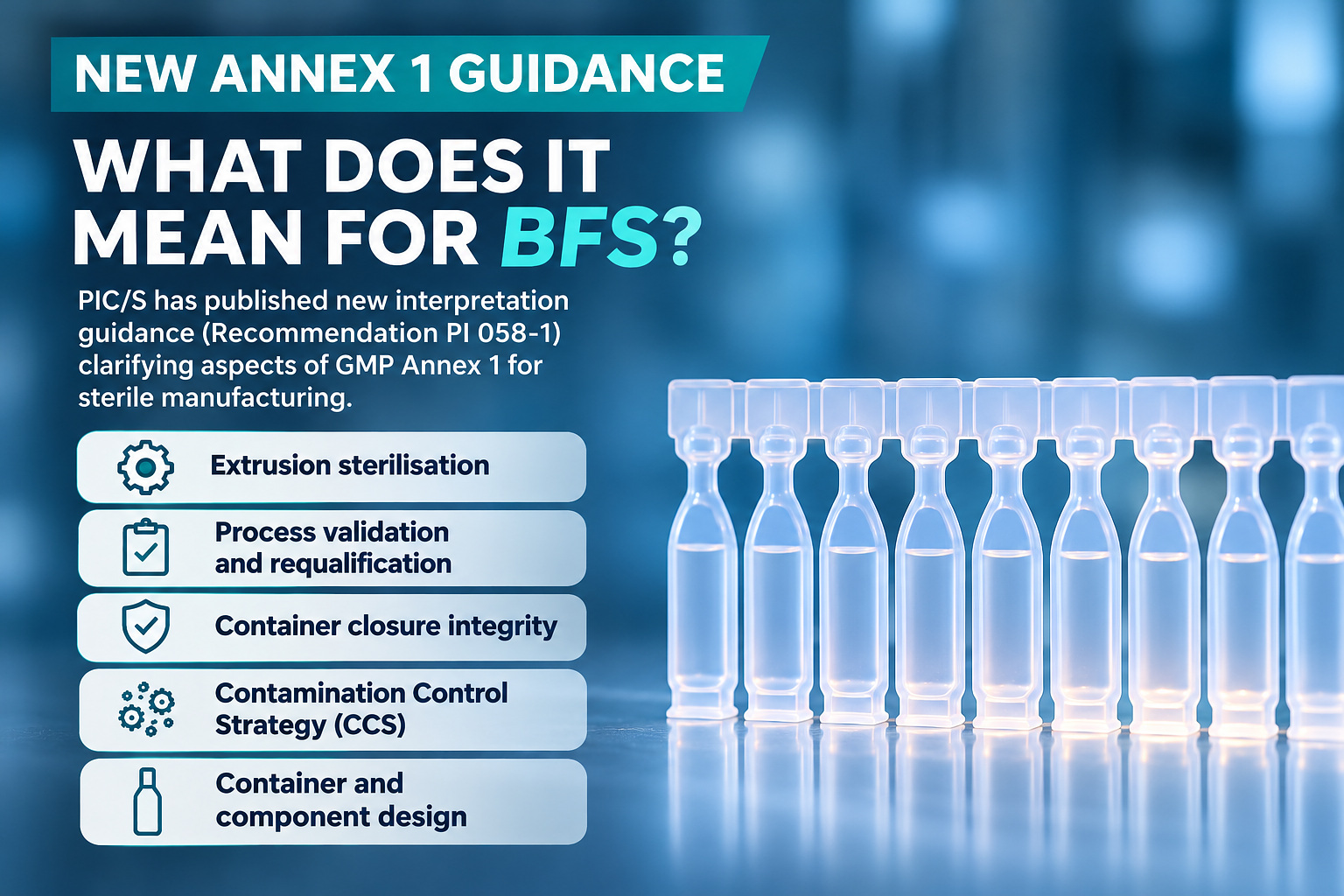
On 28 October 2026, the Pharmaceutical Inspection Co-operation Scheme (PIC/S) published new guidance clarifying the interpretation of GMP Annex 1, including several important points directly relevant to Blow-Fill-Seal (BFS) technology.
Developed through a joint PIC/S, EMA and WHO working group, Recommendation PI 058-1 aims to provide greater consistency in how existing Annex 1 requirements are interpreted and applied.
Importantly, the guidance does not introduce new GMP requirements, but offers clarification on areas that have raised questions since the revised Annex 1 came into effect.
For manufacturers operating BFS equipment, several areas are particularly relevant.
1. BFS Extrusion Sterilisation and Validation
One of the most significant clarifications relates to the sterilisation capability of BFS extrusion systems.
The guidance confirms that initial validation should include bacterial-spore studies to demonstrate effective inactivation.
However, the need to repeat viable-spore studies during routine requalification should be determined through a product- and patient-centred risk assessment.
Manufacturers should also identify and monitor critical extrusion parameters, including temperature, extrusion speed and polymer mass.
Why it matters: The guidance reinforces the importance of demonstrating ongoing process control through validated operating parameters and appropriate monitoring.
2. Container Closure Integrity Testing (CCIT)
Container closure integrity remains essential to ensuring sterile pharmaceutical products maintain an effective barrier against contamination.
The guidance provides clarification on testing expectations for non-fusion closure systems, including the use of validated methods and appropriately justified sampling strategies.
For BFS manufacturers, container integrity also depends on factors such as polymer characteristics, mould condition, sealing parameters and container design.
Why it matters: Manufacturers must ensure that integrity-testing methods are suitable for their specific container and closure configuration.
3. Contamination Control Strategy (CCS)
The Contamination Control Strategy remains central to GMP Annex 1 compliance.
The new guidance emphasises the importance of continuously evaluating the effectiveness of contamination-control measures, with formal reviews recommended at least annually and following significant changes or deviations.
For BFS operations, this includes consideration of equipment design, environmental monitoring, maintenance, operator interventions and process controls.
Although BFS technology reduces the need for direct operator intervention through its automated form-fill-seal process, effective contamination control remains essential.
4. BFS Container and Component Design
The guidance also addresses BFS containers incorporating separately manufactured components.
Where additional components form part of the critical fluid pathway, manufacturers must consider whether all relevant surfaces can be effectively sterilised.
This is particularly important for more complex container designs, where certain areas may not be directly exposed to the sterilising medium.
Why it matters: Sterilisation requirements should be considered during container development, rather than only at the validation stage.
What Does This Mean for Existing and Pre-Owned BFS Equipment?
The publication of PI 058-1 also highlights the importance of assessing the continued suitability of existing pharmaceutical manufacturing equipment.
Many BFS machines remain operational for decades with appropriate maintenance and refurbishment.
However, equipment age alone does not determine whether a machine is suitable for GMP manufacturing.
Manufacturers should consider:
- Equipment condition and maintenance history.
- Control systems and process-monitoring capabilities.
- Availability of technical and validation documentation.
- Tooling and container compatibility.
- Installation, qualification and contamination-control requirements.
For manufacturers considering pre-owned BFS equipment, these factors are particularly important when planning equipment relocation, refurbishment or integration into an existing production facility.
Supporting BFS Manufacturing Requirements
At GlobePack Equipment, we specialise in the supply of pre-owned, refurbished and unused pharmaceutical manufacturing machinery, including Blow-Fill-Seal systems.
We support manufacturers looking to expand production capacity, replace existing equipment or explore refurbishment and engineering solutions.
As regulatory expectations continue to evolve, selecting equipment that is appropriate for the intended process, supported by suitable documentation and capable of meeting applicable GMP requirements remains essential.
Conclusion
The publication of PIC/S Recommendation PI 058-1 provides welcome clarification for the sterile pharmaceutical manufacturing industry.
For BFS manufacturers, the guidance reinforces the importance of extrusion sterilisation validation, container integrity, contamination control and ongoing equipment suitability.
While it does not introduce new requirements, it offers an opportunity for manufacturers to review existing practices and ensure their processes remain appropriately controlled.
Looking to expand or upgrade your BFS manufacturing capabilities?
Contact GlobePack Equipment to discuss available BFS machinery, equipment refurbishment and engineering support.