






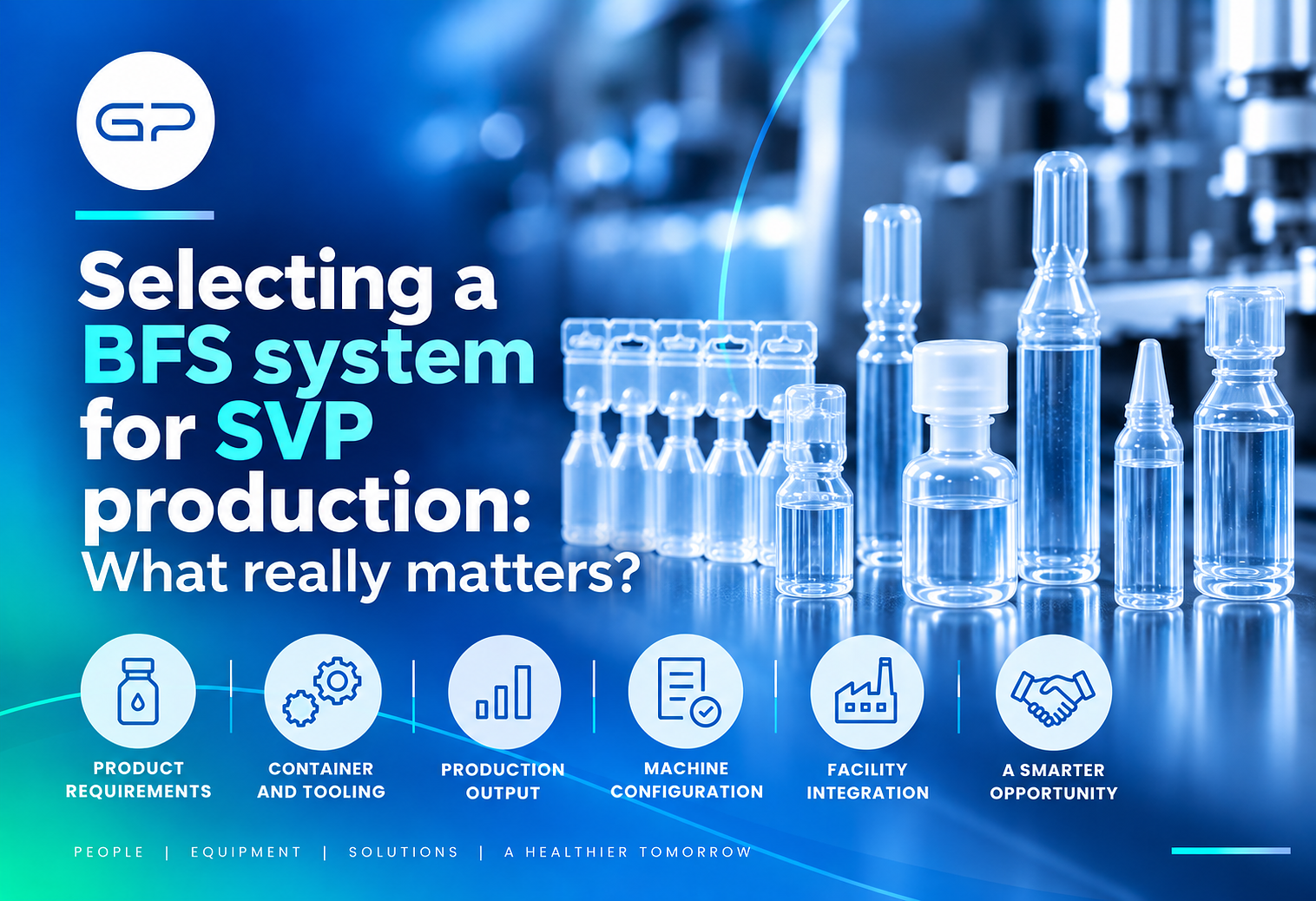
When assessing Blow-Fill-Seal (BFS) equipment for a small-volume parenteral (SVP) application, machine model and headline production speed only tell part of the story.
The more important question is whether the particular system can support the required product, container format and production strategy. SVP applications can encompass a wide range of sterile liquid products and container formats, from small unit-dose containers and ampoules to ophthalmic, respiratory and other pharmaceutical applications.
So, what should manufacturers actually be looking at when selecting a BFS system?
Product Requirements
The product should always be the starting point. Formulation characteristics, sensitivity, filling conditions, required dosing accuracy and compatibility with the proposed polymer can all influence the required BFS configuration.
Considerations may include:
- Product characteristics and viscosity
- Required fill volume
- Dosing accuracy
- Product sensitivity
- Sterility requirements
- Polymer compatibility
- Container functionality
- Required production output
Understanding what was previously manufactured on an existing machine can be useful, but it does not automatically mean another SVP product can be transferred directly onto the same system.
Container and Tooling
For SVP production, tooling is one of the most important areas to assess. Manufacturers need to understand:
- Existing container geometry
- Fill volume
- Number of cavities
- Mould dimensions
- Neck and dispensing design
- Closure/opening mechanism
- Polymer
- Individual or connected container format
- Potential for alternative tooling
SVP containers can vary considerably depending on their intended application. A small ophthalmic unit-dose container, for example, may have very different dispensing and opening requirements from another sterile liquid-dose container. Existing tooling can provide an important indication of how closely a machine aligns with the intended format, but BFS tooling is highly application-specific.
Even apparently similar containers can require changes to the mould, extrusion head or die arrangement, parison configuration, filling-needle or mandrel spacing, filling system, flash-removal equipment, controls or validated process parameters.
This is why simply matching the required fill volume to the stated machine range isn't enough.
Production Output
Headline machine speed can also be misleading when viewed in isolation. Theoretical output should be calculated from the format actually being produced:
Theoretical output (containers/hour) = containers per cycle × 3,600 ÷ cycle time (seconds)
Where containers are manufactured in connected strips or blocks, the calculation should reflect the total number of individual units produced during each cycle rather than simply looking at the number of mould cavities.
A further consideration is actual saleable output:
Indicative saleable output = theoretical output × availability × performance efficiency × quality yield
Planning assumptions should ideally be supported by data from comparable validated production runs, including demonstrated reject rates. Two machines of the same basic model can therefore have very different practical production capabilities depending on their tooling, process configuration and sustained operating performance.
Filling System and Machine Configuration
The existing filling arrangement, product-contact path, dosing principle, controls, automation, critical utilities and overall machine specification all need to be assessed against the intended SVP application. For existing BFS equipment, understanding modifications and upgrades made during the machine's operating life can be just as important as understanding its original specification. Current EU GMP Annex 1 provides an important technical framework when assessing BFS systems used for sterile manufacture.
Relevant controls can include:
- Cleaning-in-place and sterilisation-in-place (CIP/SIP) of product pipelines and filling needles or mandrels
- Extrusion temperature and speed
- Parison thickness
- Mould temperature and cooling
- Fill volume, speed and uniformity
- Critical wall thickness
- Environmental controls
- Container integrity testing
- Flash-removal settings
For an existing machine, the practical question is not simply whether these functions are present, but whether they can be appropriately qualified, maintained and supported. Available drawings, software records, manuals, material data, validation evidence and maintenance history can therefore become an important part of the equipment assessment.
Facility Integration
Moving an existing BFS machine into another pharmaceutical facility introduces another set of considerations.
These can include:
- Cleanroom integration
- Utilities
- Product preparation
- Material and personnel flows
- Environmental controls
- Downstream handling
- Inspection
- Container integrity strategy
- Qualification and validation
The machine itself is therefore only one part of the overall SVP production system.
This is why assessing an existing BFS machine requires considerably more than reviewing a specification sheet.
Existing BFS Equipment as a Project Opportunity
Where the configuration aligns with the intended product and container, existing BFS equipment can provide manufacturers with an alternative route to adding SVP production capacity. However, the commercial opportunity needs to be considered alongside the engineering work required to bring the system into its next application. Machine condition, documentation, tooling, controls, upgrades, refurbishment, installation and commissioning all form part of that assessment.
An existing machine originally configured for one SVP product may potentially be adapted for another application, but the feasibility and extent of modification need to be properly assessed.
Ultimately, the right question isn't:
"Can this machine produce SVP containers?"
It is:
"How closely does this particular BFS machine configuration align with the product and container we want to manufacture?"