






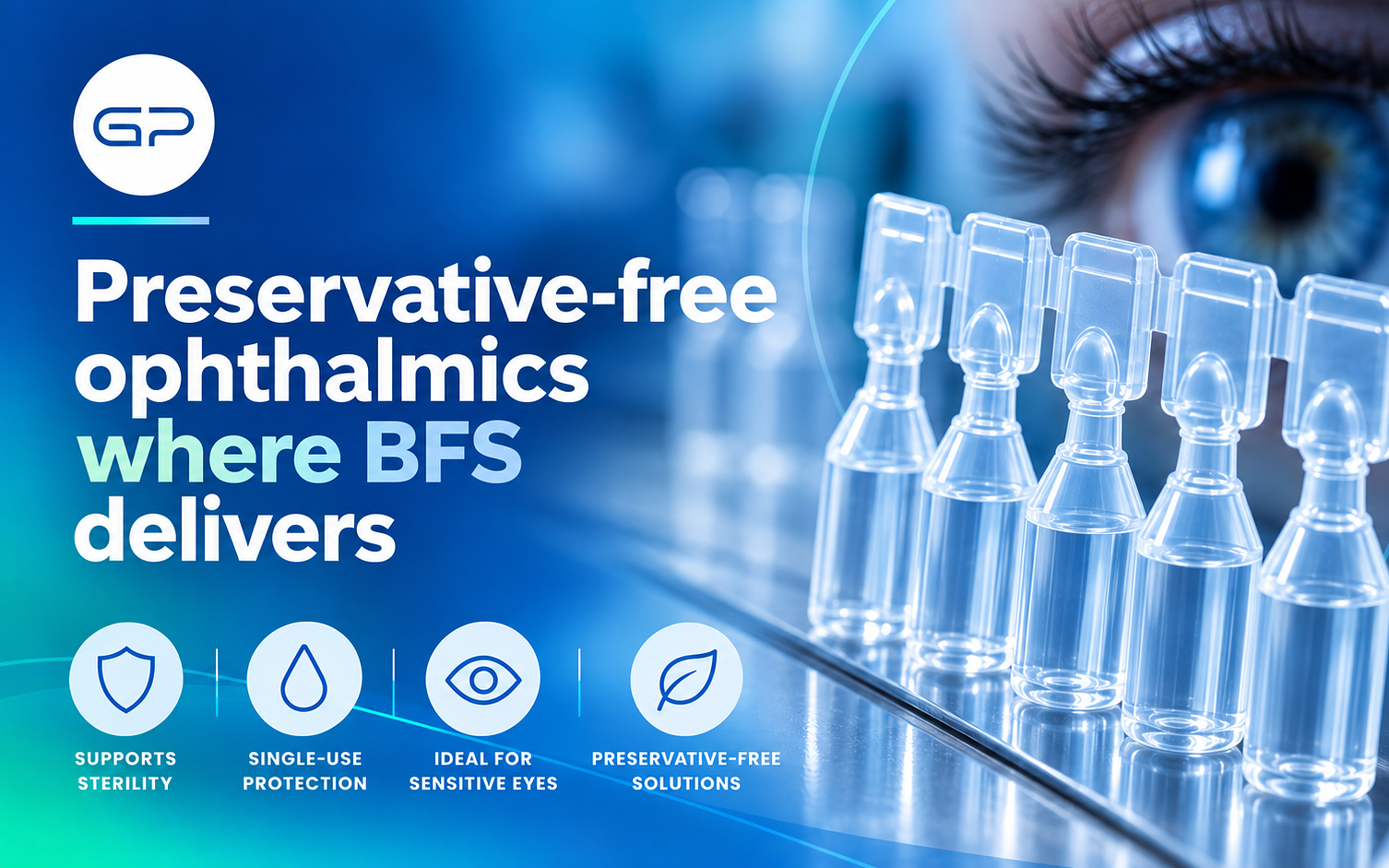
Preservative-free ophthalmics are an important and evolving area of the eye-care market.
For manufacturers, however, removing an antimicrobial preservative places even greater emphasis on the relationship between the formulation, manufacturing process and primary container.
This is an area where BFS has an established role, particularly within single-use products.
The Packaging Challenge
A conventional multidose ophthalmic product may be opened and accessed repeatedly during its in-use period.
To control in-use contamination, a multidose product may rely on inherent antimicrobial activity, an appropriate preservative or, for some preservative-free presentations, an engineered container closure system designed to protect against microbial ingress during repeated use. Preservative-free unit-dose presentations take a different approach: each single-use container remains sealed until the point of use. Specialised preservative-free multidose systems are another option, but their in-use microbial protection depends on the performance of the complete container closure system. It is in individually sealed unit-dose presentations that BFS has become particularly well established.
Why Unit-Dose?
By separating the product into individual small-volume containers, each single-use presentation can remain sealed until the point of use. This creates a very different packaging strategy from repeatedly accessing product contained within the same bottle.
For pharmaceutical manufacturers, BFS provides a practical platform for producing large quantities of small, individually sealed containers. Removing the preservative shifts still greater importance onto sterility assurance, seal integrity, container design and clear instructions for use.
Manufacturing and Packaging Become Closely Linked
Preservative-free ophthalmics also demonstrate why it is increasingly difficult to think of the filling process and primary packaging as completely separate considerations.
Manufacturers need to evaluate the complete system:
Formulation → Process → Polymer → Container → Closure → Dispensing
Factors such as polymer compatibility, container integrity, extractables and leachables, stability and dispensing performance all need to be understood within the context of the specific product.
Where BFS Fits....and Where It Doesn’t
It is important not to simplify the argument to: Preservative-free ophthalmic = BFS
BFS is one established manufacturing and packaging solution, but it is not the only approach.
Whether BFS is appropriate will depend on the formulation, intended presentation, production requirements and overall product strategy.
Where small-volume, individually sealed presentations are required, however, the combination of aseptic processing, container design flexibility and automated high-volume manufacture makes BFS particularly relevant.
The Bigger Question
Preservative-free ophthalmics raise an interesting question for BFS manufacturers:
As formulations and delivery systems continue to evolve, how much of future BFS development will be driven not simply by the filling process, but by the performance required from the container itself?