






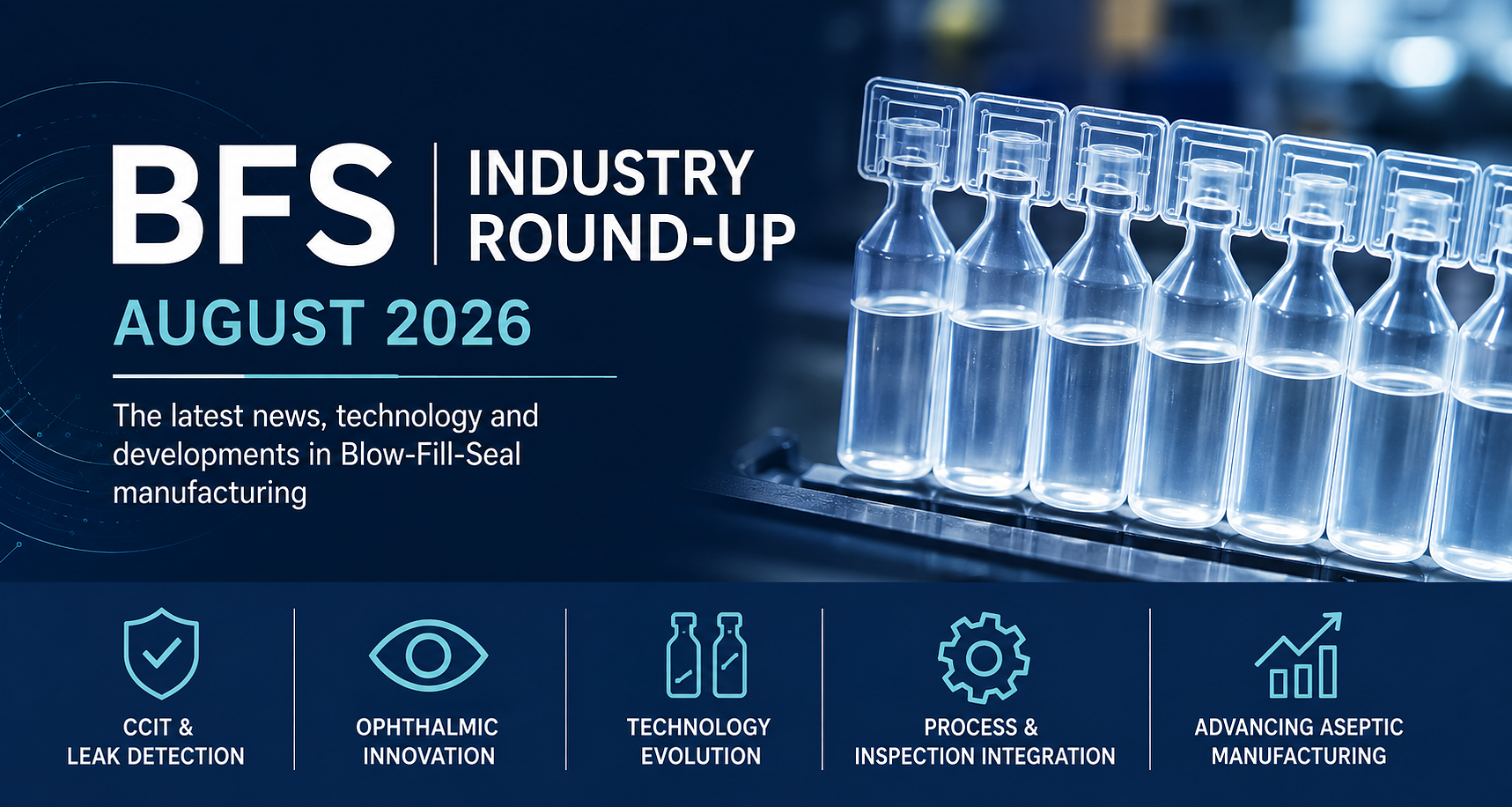
August has brought several interesting developments and technical discussions across the Blow-Fill-Seal industry, particularly around Container Closure Integrity Testing (CCIT), automated inspection, preservative-free ophthalmics and evolving BFS technology.
Rather than looking only at new machine launches, this month’s round-up also considers how regulatory expectations and developments in inspection technology are influencing the way complete BFS production lines are designed and operated.
Here are some of the key developments and discussions from across the BFS space this month.
1. CCIT & Leak Detection Remain Firmly in the Spotlight
Container Closure Integrity Testing continues to be one of the most important technical subjects for pharmaceutical BFS manufacturers.
The advantages of Blow-Fill-Seal are well established: the container is formed, filled and sealed within a highly automated process, significantly reducing the opportunities for human intervention during critical stages of aseptic production.
However, successful formation and sealing of the container does not remove the requirement to demonstrate the integrity of the finished pack.
Key points for BFS manufacturers include:
- EU GMP Annex 1 places specific requirements on containers closed by fusion, a category that includes BFS containers.
- For applicable BFS units and small-volume containers, Annex 1 requires 100% integrity testing using a validated method.
- Visual inspection alone is not considered an acceptable integrity test.
- The integrity-testing method needs to be appropriate for the container design, polymer, fill product, volume and potential defect mechanism.
- CCIT therefore needs to be considered as part of the wider Contamination Control Strategy (CCS) rather than simply as a final quality-control step.
- For existing BFS installations, this can also create a need to reassess whether current downstream inspection technology remains appropriate as regulatory expectations and testing technologies evolve.
This changes the way we should think about the complete BFS production process.
Traditionally, BFS is described simply as:
FORM → FILL → SEAL
Increasingly, the complete production strategy needs to consider:
FORM → FILL → SEAL → INSPECT → VERIFY INTEGRITY
This doesn't change the fundamental advantages of BFS. Instead, it demonstrates how BFS is evolving as part of a wider, increasingly data-driven sterile manufacturing environment.
2. New Technical Guidance Focuses Specifically on CCIT for BFS
WILCO has published a detailed technical guide examining regulatory requirements and best practice for leak testing in BFS production.
It provides a useful overview of the different considerations involved when selecting and validating an integrity-testing method for BFS containers.
Some of the key points include:
- Vacuum decay and High Voltage Leak Detection (HVLD) are two commonly used deterministic technologies for BFS applications.
- There is no single leak-testing technology that is automatically suitable for every BFS application.
- Method selection depends on factors including container geometry, polymer, fill product, conductivity, headspace and fill volume.
- Vacuum-based methods can offer non-destructive testing across a range of BFS container formats and products.
- HVLD can be particularly effective for liquid-filled containers where the product provides sufficient electrical conductivity.
- However, product characteristics matter. Low-conductivity liquids or situations where air sits behind the leak can affect the suitability of HVLD.
- Validation should establish factors such as method sensitivity, reproducibility and reliable detection of relevant defects.
- CCIT data also forms part of the wider pharmaceutical data-integrity environment, requiring appropriate traceability, documentation and control.
WILCO states that it has supplied more than 100 inline BFS inspection machines, demonstrating how established automated integrity testing has already become within the sector.
The wider point is important:
The BFS machine and the inspection system should not necessarily be viewed as completely separate equipment decisions.
For new BFS projects, inspection strategy can be considered during the initial line design.
For established lines, developments in CCIT may provide a reason to reassess existing inspection arrangements and determine whether additional automation or different testing technology would provide benefits.
3. Preservative-Free Ophthalmics Continue to Drive Interesting BFS Applications
Ophthalmics remain one of the most important application areas for Blow-Fill-Seal, particularly where manufacturers are developing preservative-free products.
One interesting example comes from Uni-Bio Science and its GeneSoft ophthalmic portfolio.
The company is progressing BFS-based ophthalmic formats including:
- 0.5 mL single-dose BFS presentation
- 3 mL multi-dose preservative-free BFS presentation
- Regulatory submissions for the new formats planned during 2026
- Further commercial development of its ophthalmic portfolio using its BFS production capability in Dongguan, China
The 0.5 mL format sits within an application already strongly associated with BFS: preservative-free unit-dose ophthalmics.
The 3 mL multi-dose presentation is particularly interesting, however.
Traditionally, one of the major benefits of unit-dose BFS ophthalmics has been the ability to provide an individual sterile dose without requiring preservatives to protect a container following repeated opening.
Multi-dose preservative-free products create a different challenge.
They require container and delivery-system designs capable of helping maintain product quality while allowing multiple administrations from the same pack.
This illustrates an important direction for BFS:
innovation isn't only happening inside the BFS machine — it is also happening in the containers and drug-delivery systems being produced by it.
For ophthalmic manufacturers, this potentially opens opportunities to combine the established benefits of BFS with more sophisticated delivery formats.
It also demonstrates how BFS applications continue to move beyond the traditional image of a simple single-dose plastic ampoule.
4. Open vs Closed Parison — An Important Technical Discussion, Not a Question of Which Is “Better”
One BFS subject receiving increasing attention is the distinction between open-parison and closed-parison technology.
It is important not to oversimplify this discussion.
Both approaches have established pharmaceutical applications and both can form part of appropriately designed and validated aseptic manufacturing processes.
The question isn't:
“Is closed parison better than open parison?”
A more useful question is:
“Which BFS architecture is most appropriate for the product and manufacturing process being designed?”
Some of the factors manufacturers may consider include:
- Product characteristics and sensitivity
- Container format and geometry
- Required production output
- Filling requirements
- Critical-zone design
- Environmental and contamination-control strategy
- Intervention requirements
- Equipment complexity
- Existing manufacturing infrastructure
- Validation strategy
- Total cost of ownership
- Future format flexibility
Closed-parison systems have attracted attention because of the way the parison and filling environment can be controlled during the process.
At the same time, open-parison BFS is an established technology with decades of pharmaceutical manufacturing experience and remains highly relevant across many applications.
Modern BFS development is therefore better viewed as an expansion of the technology choices available to manufacturers rather than the replacement of one architecture by another.
Recent developments from BFS OEMs also demonstrate how different machine architectures are being combined with technologies such as:
- Advanced automation
- Particle monitoring
- Improved environmental control
- Insertion technology
- More sophisticated container designs
- Prefilled drug-delivery concepts
- Multi-dose dispensing systems
The result is a broader BFS technology landscape where equipment can increasingly be selected and configured around a particular drug product rather than relying on a single standard machine concept.
5. BFS + Inspection Are Becoming Increasingly Integrated
One of the clearest themes emerging across the BFS industry is the increasing integration of production and inspection technology.
Historically, discussions around BFS equipment have naturally focused on the primary machine:
- Extrusion
- Container formation
- Filling
- Sealing
- Deflashing
But the finished BFS unit still needs to move through a wider quality and packaging process.
Depending on the application, this may include:
- Container Closure Integrity Testing
- Automated Visual Inspection
- Particulate inspection
- Cosmetic inspection
- Fill-level verification
- Coding and traceability
- Reject verification
- Secondary packaging
- Data collection and analysis
The important change is that these systems are increasingly being considered as part of a complete line strategy.
For example, an inline CCIT system may need to handle BFS cards or individual containers at the output rate of the BFS machine without becoming a production bottleneck.
Inspection technology also needs to account for characteristics that are particularly relevant to BFS, including:
- Transparent or semi-transparent polymer containers
- Complex container geometries
- Multiple connected units within a BFS card
- Small fill volumes
- Flexible container walls
- Variable headspace
- Different polymer characteristics
- Product conductivity
- Defects potentially occurring around seams or closure areas
This means specifying inspection equipment for BFS can be significantly different from specifying equipment for conventional glass vials.
As BFS output speeds continue to increase, the relationship between machine output, inspection capability and downstream handling becomes increasingly important.
A high-output BFS machine only provides its full production benefit if downstream equipment can reliably process the same volume.
6. Annex 1 Continues to Influence BFS Line Design
Although EU GMP Annex 1 itself isn't new, its practical implications continue to influence decisions being made around BFS manufacturing.
BFS has long been recognised for its ability to reduce operator intervention during critical stages of aseptic filling.
The current regulatory environment places particular emphasis on areas including:
- Contamination Control Strategy
- Quality Risk Management
- Reduction of human intervention
- Environmental monitoring
- Critical-zone protection
- Process validation
- Container closure integrity
- Monitoring of critical process parameters
For BFS manufacturers, the key point is that using BFS does not automatically make a process compliant with Annex 1.
The complete manufacturing process still needs to be understood, justified, validated and incorporated into the site's wider contamination-control strategy.
This includes considering:
- Equipment design
- Machine environment
- Personnel and material flows
- Interventions
- Cleaning and sterilisation
- Environmental monitoring
- Polymer handling
- Filling-system design
- Process simulation/media fills
- Container integrity
- Inspection
- Maintenance
- Data integrity
BFS can provide significant advantages in many of these areas, particularly through automation and reduced human intervention, but those advantages still need to be demonstrated within the manufacturer's pharmaceutical quality system.
7. The BFS Container Itself Is Becoming Part of the Innovation Story
One of the most interesting longer-term developments in BFS is the increasing sophistication of the container itself.
Historically, BFS is strongly associated with relatively simple formats such as:
- Ophthalmic ampoules
- Respiratory unit doses
- Saline containers
- Irrigation products
- Small-volume parenterals
- Large-volume parenterals
Those applications remain extremely important.
However, newer BFS concepts are increasingly exploring more complex drug-delivery formats.
These can include:
- Multi-dose ophthalmic containers
- Prefilled delivery devices
- Containers incorporating inserted components
- More complex closure systems
- Specialised dispensing features
- Patient-friendly opening mechanisms
- Custom container geometries
Insertion technology is particularly interesting because it allows a separately manufactured component to be incorporated into the BFS container during the manufacturing process.
This potentially expands the design possibilities available to pharmaceutical manufacturers and moves BFS further into the drug-delivery device space.
For the BFS industry, this could become one of the most important areas of innovation over the next decade.
8. BFS Is Increasingly Being Viewed as an Aseptic Manufacturing Strategy
Another interesting theme in recent technical literature is the way BFS is being discussed.
Rather than describing it simply as a packaging technology, industry articles increasingly frame BFS as an integrated aseptic manufacturing process.
That distinction matters.
Conventional aseptic filling typically requires a pre-manufactured primary container to move through several preparation, sterilisation and filling stages.
With BFS, container manufacture becomes part of the aseptic process itself.
The container is:
formed → filled → sealed
within a highly automated sequence.
This can provide several potential advantages depending on the application:
- Reduced operator intervention
- Compact production footprint
- High production speeds
- Flexible container design
- Reduced reliance on pre-manufactured primary containers
- Integration of container manufacture and aseptic filling
- Potential supply-chain advantages
- Suitability for unit-dose production
- Opportunities for preservative-free delivery
This is why the question for pharmaceutical manufacturers is increasingly not simply:
“Should we package this product in BFS?”
It can instead become:
“Could BFS provide the most appropriate aseptic manufacturing strategy for this product?”
That is a much broader conversation.
What Are the Key BFS Trends to Watch?
Looking across the developments and technical discussions this month, several themes stand out.
CCIT and automated inspection
- Integrity testing is becoming increasingly integrated into BFS production strategies.
- Deterministic methods continue to gain importance.
- Testing technology must be selected around the specific product and container rather than applying a single solution to every BFS application.
- Existing BFS lines may increasingly require inspection upgrades as expectations evolve.
Preservative-free drug delivery
- Ophthalmics remain a major opportunity for BFS.
- Unit-dose applications continue to be important.
- Multi-dose preservative-free formats could create additional opportunities.
- Container and dispensing design are becoming increasingly important parts of the BFS proposition.
More sophisticated BFS containers
- BFS is moving beyond conventional ampoules and bottles.
- Insertion technologies could enable increasingly complex delivery systems.
- Drug-device combination applications represent an interesting future direction.
Open and closed-parison technology
- Both remain relevant.
- Technology selection should be application-specific.
- Contamination control, product requirements, output, flexibility and total cost all need to be considered.
- The discussion should focus on appropriate process design rather than declaring one architecture universally superior.
BFS + inspection as one complete line
- The BFS machine cannot be considered in isolation.
- CCIT, visual inspection and downstream packaging need to match machine output.
- Complete-line integration is likely to become increasingly important when specifying future BFS projects.
August BFS Takeaway
Perhaps the biggest takeaway from August isn't one individual machine launch or announcement.
It's how the definition of a BFS production line is expanding.
The industry has traditionally centred on three words:
BLOW → FILL → SEAL
Those three stages remain at the heart of the technology.
But the wider manufacturing conversation now increasingly includes:
contamination control → process monitoring → container design → CCIT → automated inspection → data → downstream integration
At the same time, applications are continuing to develop — particularly within preservative-free ophthalmics and more sophisticated drug-delivery formats.
That doesn't mean established BFS technology is becoming obsolete.
Quite the opposite.
It demonstrates how a technology with decades of pharmaceutical manufacturing history continues to adapt to new products, regulatory expectations and manufacturing strategies.
And as BFS develops further, perhaps the most important question isn't simply what will the next generation of BFS machine look like?
It's:
What will the next generation of the complete BFS manufacturing process look like?